This baked salmon with potatoes is a one-tray dinner: baby potatoes roast with olive oil, garlic and herbs until golden, then salmon fillets join them for the last 12 to 15 minutes with plenty of lemon. It serves 4, takes about 50 minutes with very little hands-on work, and needs only one tray to wash up.
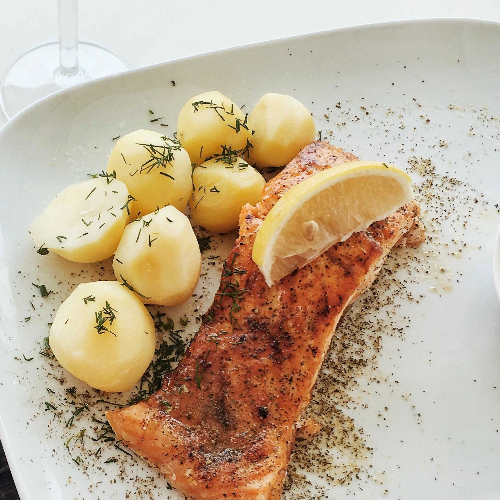
- Serves: 4
- Prep time: 10 minutes
- Cook time: 40 minutes
- Total time: 50 minutes
Ingredients
- 700 g (1 lb 9 oz) baby potatoes, halved (or larger potatoes cut into 3 cm chunks)
- 2 tablespoons olive oil
- 2 garlic cloves, finely chopped
- 1 tablespoon fresh rosemary or thyme leaves, chopped (or 1 teaspoon dried)
- ¾ teaspoon salt, divided, and black pepper
- 4 salmon fillets, about 140 g (5 oz) each, skin on or off
- 1 lemon, half thinly sliced and half for squeezing
- Fresh dill or parsley, to serve (optional)
Method
- Heat the oven to 220°C (425°F), or 200°C (400°F) for a fan oven.
- Put the potatoes on a large baking tray. Toss with 1½ tablespoons of the oil, the garlic, herbs, ½ teaspoon of the salt and some pepper. Spread them out in a single layer, cut side down.
- Roast for 25 minutes, until the potatoes are golden underneath and nearly tender.
- Pat the salmon dry and rub with the remaining oil, salt and pepper. Push the potatoes to the sides of the tray, turning them over, and lay the salmon in the middle. Top each fillet with a lemon slice.
- Roast for another 12 to 15 minutes, until the salmon flakes easily and is opaque in the center, and the potatoes are tender when pierced with a knife.
- Squeeze the remaining lemon over the tray, scatter over dill or parsley, and serve.
How to tell when salmon is done
The USDA’s safe temperature chart lists 63°C (145°F) as the safe internal temperature for fish. With a food thermometer, check the thickest part of the thickest fillet. Without one, the fish should be opaque rather than translucent in the middle and flake easily with a fork. Thin fillets cook faster than thick ones, so start checking at 12 minutes.
Tips for the best result
- Give the potatoes a head start. They take much longer than the fish, so they always go in first.
- Don’t crowd the tray. Potatoes packed too closely steam instead of roasting. Use two trays if needed.
- Cut side down gives the potatoes a golden, crisp face.
- Dry the salmon with paper towels so the oil and seasoning stick.
- Thick fillets cook more evenly than thin tail pieces. If you have both, add the thin pieces a few minutes later.
Swaps and variations
- Other fish: cod, haddock or trout work too. White fish fillets often cook in 10 to 12 minutes.
- Add vegetables: add green beans, asparagus or cherry tomatoes with the salmon in step 4.
- Different flavors: swap the herbs for smoked paprika, or brush the salmon with a mix of Dijon mustard and a little honey.
- Sweet potato: use sweet potato chunks, which cook slightly faster, so check them after 20 minutes.
- Lower carb: replace the potatoes with cauliflower florets and broccoli, which need about 20 minutes in total.
Why salmon is worth eating
Salmon is an oily fish, rich in the omega-3 fats EPA and DHA. Per 100 g, raw farmed Atlantic salmon has about 0.9 g of EPA and 1.1 g of DHA, according to USDA FoodData Central. The US Food and Drug Administration lists salmon among its “best choices” for low mercury and recommends at least 8 ounces (about 225 g) of seafood a week for adults on a 2,000 calorie diet. Our guide to omega-3 foods explains more.
Storage and reheating
Refrigerate leftovers within 2 hours and eat them within 3 to 4 days, as the USDA’s leftovers guidance recommends. Leftover salmon is good cold, flaked into a salad or wrap. To reheat, cover and warm gently in a low oven until hot all the way through, because high heat dries it out.
Nutrition per serving (estimate)
One serving is one salmon fillet and a quarter of the potatoes. These figures are estimates calculated from USDA FoodData Central values for farmed Atlantic salmon and the other ingredients.
| Nutrient | Per serving |
|---|---|
| Calories | 495 kcal |
| Protein | 32 g |
| Carbohydrate | 33 g |
| Fiber | 4 g |
| Sugars | 2 g |
| Fat | 26 g |
| Saturated fat | 5 g |
| Sodium | 530 mg |
Most of the fat comes from the salmon itself and is largely unsaturated. Wild salmon is usually leaner than farmed, so the calories will be lower if you use it.
Contains: fish. Check the labels on packaged ingredients if you’re cooking for someone with an allergy.
What to serve with it
- Steamed green beans, broccoli or a green salad.
- A spoonful of plain Greek yogurt mixed with dill and lemon as a quick sauce.
- Our green foods list has more vegetable ideas.
This article is general information, not medical advice. Nutrition figures are estimates from USDA FoodData Central and will change with the brands and amounts you use. If you follow a diet for a medical reason, check the recipe with your doctor or dietitian.