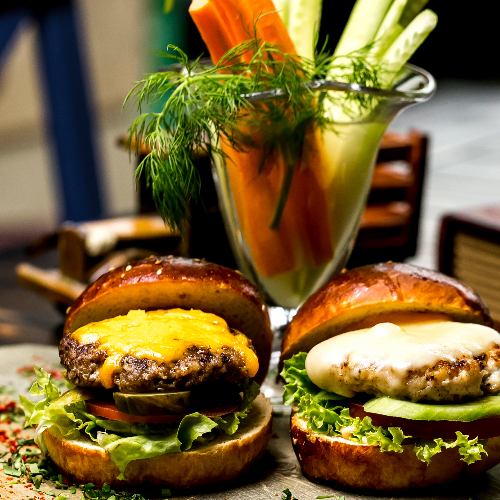
These homemade burgers are juicy beef patties seasoned simply with grated onion, salt and pepper, cooked in a hot pan or on the grill, and served in whole wheat buns with lettuce, tomato, red onion and pickles. Homemade patties have no fillers, you choose the beef, and they take about 25 minutes. The recipe makes 4 burgers. Serve them with carrot and cucumber sticks instead of fries for a lighter meal.
- Serves: 4 (one burger each)
- Prep time: 15 minutes, plus 15 minutes chilling
- Cook time: 8 to 10 minutes
- Total time: about 40 minutes
Ingredients
Burgers
- 500 g (1.1 lb) ground beef (beef mince), about 15% fat
- 1 small onion (about 60 g), finely grated
- ½ teaspoon salt
- ½ teaspoon black pepper
- 1 teaspoon Worcestershire sauce (optional)
- A little oil for the pan or grill
To serve
- 4 whole wheat burger buns
- 4 crisp lettuce leaves, such as romaine
- 1 large tomato, sliced
- A few thin slices of red onion
- Sliced dill pickles
- Ketchup, mustard or mayonnaise
- Carrot and cucumber sticks on the side
Method
- Put the beef in a bowl with the grated onion and its juice, salt, pepper and Worcestershire sauce.
- Mix gently with your fingertips until just combined. Overworking the meat makes burgers dense and tough.
- Divide into 4 equal portions and shape each into a patty about 2 cm (¾ inch) thick and slightly wider than your buns, because they shrink as they cook.
- Press a shallow dip into the center of each patty with your thumb. This stops them puffing up into a dome.
- Chill the patties on a plate for 15 minutes so they hold together. Wash your hands, the bowl and anything the raw meat touched.
- Heat a heavy frying pan, griddle or grill to medium-high and brush it with a little oil.
- Cook the patties for 4 to 5 minutes, without pressing or moving them, until a brown crust forms. Flip and cook for another 4 to 5 minutes.
- Check they’re done: the center of each patty should reach 71°C (160°F), the safe temperature for ground beef in the USDA’s chart. Without a thermometer, cut into one: there should be no pink meat and the juices should run clear.
- Rest the burgers for 2 minutes while you toast the buns, cut side down, in the pan.
- Build the burgers with lettuce, tomato, onion, pickles and your choice of sauce.
Why burgers need cooking through
A steak can be served rare because bacteria sit on its outside surface, which gets seared. Grinding beef mixes any surface bacteria, such as E. coli, all the way through the meat, so the inside of a burger has to be cooked properly. Use a separate plate and utensils for raw and cooked burgers, and don’t put cooked patties back on the plate that held the raw ones.
Tips for juicy burgers
- Choose beef with some fat. About 15% to 20% fat keeps burgers moist. Very lean beef dries out.
- Salt just before shaping, not hours ahead, which makes the texture sausage-like.
- Don’t press the burgers with a spatula while cooking. It squeezes out the juices.
- Flip once. Leaving the patties alone builds a better crust.
- Use a thermometer. It’s the only sure way to cook burgers safely without overcooking them.
Swaps and variations
- Cheeseburger: lay a slice of cheddar on each patty for the last minute and cover the pan to melt it.
- Turkey or chicken burgers: use ground turkey or chicken and cook to 74°C (165°F), the USDA temperature for poultry.
- Lettuce wrap: skip the bun and wrap the burger in large lettuce leaves for a low-carb meal.
- Herby: add 2 tablespoons of chopped parsley and a crushed garlic clove to the meat.
- Smaller portions: make 6 smaller patties for children, cooking them for about 3 minutes per side and checking the temperature.
Nutrition per serving (estimate)
One serving is one burger in a whole wheat bun with lettuce, tomato, red onion, pickles and 1 tablespoon of ketchup. These figures were calculated from USDA FoodData Central values for cooked 85% lean beef patties (about 90 g cooked per burger), onion, whole wheat burger buns, romaine, tomato, dill pickles, ketchup and salt.
| Nutrient | Per serving |
|---|---|
| Calories | 410 kcal |
| Protein | 31 g |
| Carbohydrate | 33 g |
| Fiber | 4.5 g |
| Sugars | 8.5 g |
| Fat | 16.5 g |
| Saturated fat | 6 g |
| Sodium | 840 mg |
Burgers are high in salt once the bun, pickles and ketchup are added. That’s about 2.1 g of salt per burger, over a third of the 5 g a day the World Health Organization recommends as a maximum. To cut it, skip the pickles, use mustard or fresh salsa instead of ketchup, and halve the salt in the patties.
A side of 100 g each of carrot and cucumber sticks adds about 56 kcal and 3 g of fiber, far less than a portion of fries. If you’d like fries now and then, our oven-baked fries use much less oil than deep-fried ones.
Contains: wheat (gluten) in the buns, and fish if your Worcestershire sauce contains anchovies. Some buns also contain milk, egg, soy or sesame, so check the label.
Storage
Raw patties can be made up to a day ahead and kept covered on the bottom shelf of the fridge. To freeze, separate them with baking paper and freeze for up to 3 months, then thaw in the fridge before cooking. Keep cooked burgers in the fridge and eat them within 3 to 4 days, as the USDA advises, reheating them until steaming hot.
What to serve with them
- Carrot, cucumber and pepper sticks with a yogurt dip.
- A crunchy coleslaw made with a yogurt dressing.
- Corn on the cob.
- A big green salad.
For a balanced plate, aim for about half vegetables. Our guide to building a balanced meal shows how.
Common questions
How do I stop my burgers falling apart?
Chill the patties before cooking, make sure the pan is hot, and wait until a crust forms before flipping. Beef with some fat holds together better than very lean beef.
Do I need egg or breadcrumbs?
No. Good ground beef holds together on its own. Egg and breadcrumbs make a burger closer to a meatloaf.
This article is general information, not medical advice. Nutrition figures are estimates from USDA FoodData Central and will change with the brands and amounts you use. If you follow a diet for a medical reason, check the recipe with your doctor or dietitian.