Cruciferous vegetables are the cabbage family: broccoli, Brussels sprouts, cabbage, cauliflower, kale, bok choy, arugula, collard greens, watercress, radishes and turnips. They’re rich in vitamin C, vitamin K, folate and fiber, and they contain sulfur compounds called glucosinolates that give them their sharp taste. In large observational studies, people who eat more of them have lower rates of several cancers and of heart disease, as the Linus Pauling Institute summarizes, although that doesn’t prove the vegetables are the cause. How you cook them matters: steaming, stir-frying and microwaving keep more of their useful compounds than boiling.
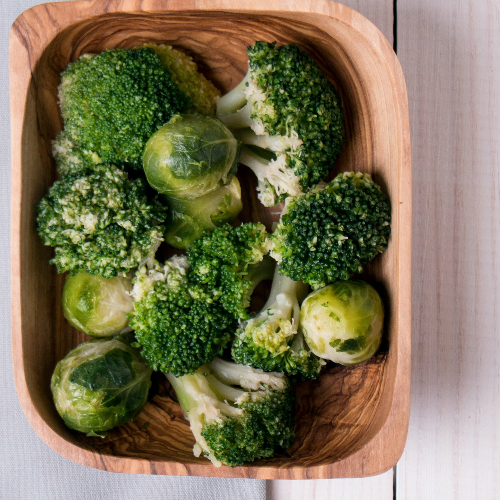
Common cruciferous vegetables
Per 80 g portion of raw vegetable, calculated from USDA FoodData Central values:
| Vegetable (80 g, raw) | Calories | Fiber | Vitamin C | Vitamin K |
|---|---|---|---|---|
| Broccoli | 27 kcal | 2.1 g | 71 mg | 82 mcg |
| Brussels sprouts | 34 kcal | 3.0 g | 68 mg | 142 mcg |
| Kale | 28 kcal | 3.3 g | 75 mg | 312 mcg |
| Cauliflower | 20 kcal | 1.6 g | 39 mg | 12 mcg |
| Green cabbage | 20 kcal | 2.0 g | 29 mg | 61 mcg |
| Red cabbage | 25 kcal | 1.7 g | 46 mg | 31 mcg |
| Arugula (rocket) | 20 kcal | 1.3 g | 12 mg | 87 mcg |
| Collard greens | 26 kcal | 3.2 g | 28 mg | 350 mcg |
An 80 g portion of broccoli, Brussels sprouts or kale provides most of an adult’s daily vitamin C (75 to 90 mg). Leafy crucifers like kale and collards are very rich in vitamin K, which helps blood clot and supports bones.
What makes them different
Cruciferous vegetables are unusual because of glucosinolates, sulfur-containing compounds that give them their pungent, slightly bitter taste. The Linus Pauling Institute explains that when you chop or chew the raw vegetables, an enzyme called myrosinase is released and turns glucosinolates into active compounds such as isothiocyanates (including sulforaphane, found mainly in broccoli) and indole-3-carbinol. These compounds have a range of biological effects in laboratory research, which may help explain the health links seen in people.
What the evidence shows
- Cancer: high intakes have been linked with lower risk of several cancers, including bladder, breast, colorectal, lung and prostate cancer, in observational studies summarized by the Linus Pauling Institute. These studies can’t prove cause and effect.
- Heart health and mortality: in two large Chinese cohort studies of about 135,000 adults, described by the Linus Pauling Institute, those who ate the most cruciferous vegetables had a 22% lower risk of death from any cause and a 31% lower risk of death from cardiovascular disease.
- Inflammation: in a study of 1,005 Chinese women, those with the highest intake had 13% to 25% lower blood levels of three markers of inflammation than those with the lowest intake.
The fair summary: eating more cruciferous vegetables is linked with better health, they’re nutritious and low in calories, and there’s no downside to eating them regularly.
How to cook them to keep the benefits
The Linus Pauling Institute notes that boiling reduces glucosinolates much more than steaming, microwaving or stir-frying, and that boiling also inactivates myrosinase.
- Steam broccoli and cauliflower for 3 to 5 minutes until just tender.
- Stir-fry cabbage, bok choy and broccoli quickly over high heat.
- Roast Brussels sprouts and cauliflower at 200°C (400°F) for 20 to 25 minutes, until browned at the edges. Roasting makes them sweeter and less bitter.
- Eat some raw: shredded cabbage in coleslaw, arugula in salads, or our broccoli salad.
- Chop and wait: cutting broccoli a few minutes before cooking gives the enzyme time to work.
- If you boil, use little water and cook briefly, or use the cooking water in soup.
Our guide on how to cook kale has five easy methods.
Things to be aware of
Warfarin and vitamin K
If you take warfarin, you don’t need to avoid these vegetables, but the NIH Office of Dietary Supplements advises keeping your vitamin K intake steady from day to day, because sudden changes affect how warfarin works. Talk to your doctor before making a big change, such as starting a daily kale smoothie.
Thyroid
Very large amounts of raw cruciferous vegetables have caused an underactive thyroid in animals, as the Linus Pauling Institute notes. In people, normal amounts eaten as part of a varied diet with enough iodine aren’t a concern. If you have a thyroid condition, cooking them and eating normal portions is sensible, and you can ask your doctor if you’re unsure.
Gas and bloating
Cruciferous vegetables contain fiber and sugars that gut bacteria ferment, which can cause wind. Increase portions gradually, and cook them if raw ones bother you. If you have irritable bowel syndrome, some, such as cauliflower, may trigger symptoms.
Easy ways to eat more
- Add shredded cabbage to stir-fries, soups and tacos.
- Swap rice for cauliflower rice, as in our cauliflower fried rice.
- Roast a tray of Brussels sprouts and broccoli with olive oil and garlic.
- Use arugula or watercress as a salad base.
- Add kale or spinach to smoothies and pasta sauces.
- Snack on radishes with hummus.
Common questions
Which cruciferous vegetable is the healthiest?
They’re all nutritious, and variety is best. Broccoli, Brussels sprouts and kale are especially rich in vitamin C and vitamin K.
Are frozen cruciferous vegetables as good as fresh?
Frozen broccoli and cauliflower keep most of their vitamins and are a convenient choice. Blanching before freezing reduces myrosinase, so their active compounds may form less readily, but they still provide fiber, vitamins and minerals.
Is broccoli better raw or cooked?
Both are good. Raw broccoli keeps the most vitamin C and enzyme activity, while lightly steamed broccoli is easier to digest for many people.
Are radishes and wasabi cruciferous vegetables?
Yes. Radishes, horseradish, wasabi, watercress, mustard greens, turnips and kohlrabi are all part of the cabbage family, along with the more familiar broccoli and cabbage.
How much should I eat?
There’s no specific target for cruciferous vegetables. Aim for at least 400 g of fruit and vegetables a day, as the WHO recommends, and include a portion of cruciferous vegetables on most days.
This article is general information, not medical advice. Talk to your doctor or a registered dietitian before making big changes to how you eat, especially if you have a health condition, take regular medication, or are pregnant or breastfeeding.