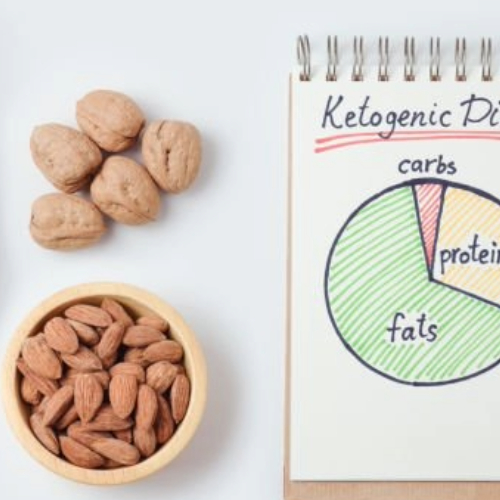
Most keto plans get about 70 to 80% of their calories from fat, 10 to 20% from protein and only 5 to 10% from carbohydrate, according to Harvard’s Nutrition Source. On a 2,000 calorie day, that works out to roughly 165 g of fat, 75 g of protein and 40 g of carbohydrate. The carbohydrate limit is the part that keeps you in ketosis. Protein is the part most worth getting right, and fat simply fills the rest of your energy needs.
What “macros” means
Macros, short for macronutrients, are the three nutrients that supply calories: fat, protein and carbohydrate. Each gives a different amount of energy:
- Fat: 9 calories per gram
- Protein: 4 calories per gram
- Carbohydrate: 4 calories per gram
That’s why a small amount of fat, in grams, can supply a large share of your calories. On keto, fat usually makes up most of the energy while being a smaller pile on the plate than vegetables.
Typical keto macro ranges
| Macro | Share of calories | Grams on a 2,000 calorie day |
|---|---|---|
| Fat | 70 to 80% | about 155 to 180 g |
| Protein | 10 to 20% | about 50 to 100 g |
| Carbohydrate | 5 to 10% | about 25 to 50 g |
Ranges based on Harvard’s Nutrition Source. Grams calculated from 9 calories per gram of fat and 4 per gram of protein and carbohydrate.
Harvard’s own example for a 2,000 calorie day is 165 g of fat, 40 g of carbohydrate and 75 g of protein. Here’s how that adds up:
- Fat: 165 g × 9 = 1,485 calories (76%)
- Carbohydrate: 40 g × 4 = 160 calories (8%)
- Protein: 75 g × 4 = 300 calories (15%)
- Total: 1,945 calories
Step 1: Set your carbohydrate limit
Carbohydrate is the macro that decides whether you’re in ketosis. Harvard notes that keto plans usually keep it under 50 g a day, and some go as low as 20 g.
Many people count net carbs, which is total carbohydrate minus fiber. Our guide to calculating net carbs explains how to work it out from a label. Whichever you count, be consistent, and get most of your carbohydrate from non-starchy vegetables, which also bring fiber, vitamins and minerals. The keto food list shows the carb counts of common foods.
Step 2: Get enough protein
Protein is the macro most worth getting right, because your body needs it to maintain muscle and other tissues, and it’s easy to fall short when you’re focused on fat. The official minimum, the Recommended Dietary Allowance, is 0.8 g of protein per kilogram of body weight a day (0.36 g per pound), as Harvard Health explains.
Worked example: say you weigh 70 kg (154 lb). The minimum is 70 × 0.8 = 56 g of protein a day. Your own needs may be higher depending on your age, activity and health, and a registered dietitian can help you set a figure that fits.
Good keto protein sources include eggs, fish, chicken, meat, Greek yogurt, cheese and tofu. Spread protein across your meals rather than saving it all for dinner.
Step 3: Let fat fill the rest
Once carbohydrate and protein are set, fat makes up the remaining calories. You don’t need to hit a fat number exactly. If you’re trying to lose weight, eating fat “to target” can mean eating more than you need, so many people treat the fat figure as a ceiling rather than a goal.
The type of fat matters for heart health. The NHS explains that eating too much saturated fat can raise LDL (“bad”) cholesterol, and that replacing saturated fats with some unsaturated fats can help lower cholesterol. On keto, that means making olive oil, avocado, nuts, seeds and oily fish your main fats, with butter, cream and fatty processed meat in smaller amounts.
A worked example: one keto day
This example day is for illustration only, using rounded values from USDA FoodData Central:
| Meal | What’s on the plate | Rough net carbs |
|---|---|---|
| Breakfast | 2 eggs fried in olive oil, 100 g spinach, half an avocado | about 3 g |
| Lunch | Salad of 100 g lettuce and 100 g tomatoes with 100 g grilled chicken, 50 g cheese and olive oil dressing | about 5 g |
| Snack | 30 g pecans | about 1 g |
| Dinner | 150 g salmon, 200 g roasted broccoli and cauliflower with olive oil | about 7 g |
| Dessert | 80 g raspberries with 2 tablespoons of heavy cream | about 5 g |
That comes to roughly 21 g of net carbs, close to a strict keto day. The vegetable portions are generous on purpose: they’re where most of the fiber, potassium, folate and vitamin C comes from.
How to track macros without obsessing
- Track for two weeks, then ease off. A few weeks of logging teaches you what a 20 g or 40 g carb day looks like. After that, many people can eyeball it.
- Weigh the tricky foods. Nuts, cheese, oils and berries are easy to underestimate, so a kitchen scale helps.
- Check labels for net carbs per serving, and note the serving size, which is often smaller than what you’d eat.
- Don’t chase perfect numbers. A day that’s a few grams over isn’t a failure.
If tracking makes you anxious about food or starts to take over your day, that’s a sign to step back and talk to your doctor or a dietitian.
Do macros change over time?
They can. If you lose weight, your calorie needs usually fall, so the same plan may stop working, which is one reason weight loss stalls. Activity, age and health conditions also change what’s right for you. Reviewing your plan every few months, ideally with a registered dietitian, is a sensible habit.
Before you start
Safety note: A ketogenic diet isn’t safe for everyone. Don’t start one without medical supervision if you have type 1 diabetes, take insulin or other diabetes medicines (especially SGLT2 inhibitors such as empagliflozin or dapagliflozin), take medicine for high blood pressure, have kidney, liver, pancreas or gallbladder disease, are underweight or have had an eating disorder, or are pregnant or breastfeeding. Children should only follow keto as a medical treatment run by a specialist team. A 2026 review of keto’s contraindications lists these and other situations that need care, so talk to your doctor first if any apply to you.
This article is general information, not medical advice. Talk to your doctor or a registered dietitian before making big changes to how you eat, especially if you have a health condition, take regular medication, or are pregnant or breastfeeding.