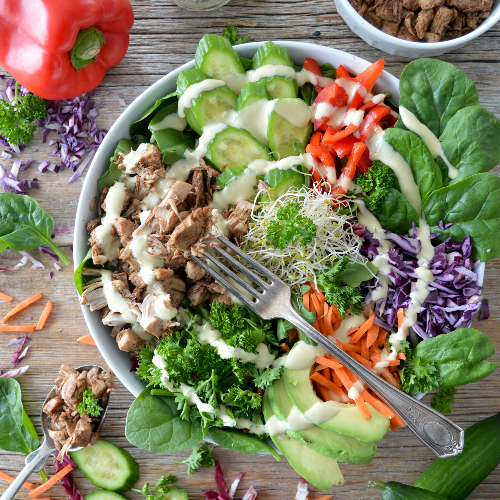
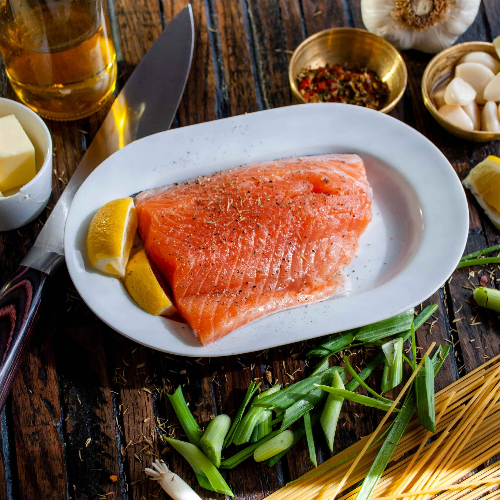
A keto diet is built on foods that are very low in carbohydrate: meat, fish, eggs, most cheese, non-starchy vegetables, avocado, nuts, seeds and plain fats such as olive oil and butter. It cuts out or sharply limits bread, rice, pasta, potatoes, sugar, most fruit, beans and lentils. Harvard’s Nutrition Source notes that most keto plans keep carbohydrate under 50 g a day, and some go as low as 20 g. The lists below show where each food fits.

How to use this list
Two numbers matter on keto: total carbohydrate and fiber. Most keto plans count “net carbs”, which is total carbohydrate minus fiber, because fiber isn’t digested into sugar. Our guide to calculating net carbs explains the method and its limits.
The figures in this article come from USDA FoodData Central and are given per 100 g (3.5 oz), so you can compare foods fairly. Real portions vary: you might eat 30 g of almonds but 200 g of broccoli, so always think about how much you’ll actually eat.
If your daily limit is 20 g of net carbs, every food choice counts. At 50 g, there’s room for more vegetables, some berries and the occasional small portion of something starchier.
Foods to eat freely on keto
These foods have little or no carbohydrate. Portions still matter for calories, but they won’t use up much of your carb budget.
- Meat and poultry: beef, lamb, pork, chicken and turkey contain essentially no carbohydrate. Check processed meats such as sausages and ham, which can contain added sugar or starch.
- Fish and seafood: salmon, sardines, mackerel, tuna and white fish have no carbohydrate. Our guide on choosing keto macros explains how much protein to aim for.
- Eggs: about 0.7 g of carbohydrate per 100 g, roughly two large eggs, according to USDA FoodData Central.
- Plain fats and oils: olive oil, avocado oil and butter have little or no carbohydrate.
- Hard and soft cheeses: most aged cheeses are very low in carbohydrate. Check the label, because values vary by type and brand.
Low-carb vegetables
Non-starchy vegetables are the main source of fiber, vitamins and minerals on keto, so they deserve a large share of your plate. Here are net carbs per 100 g, raw:
| Vegetable | Total carbs | Fiber | Net carbs |
|---|---|---|---|
| Spinach | 3.6 g | 2.2 g | 1.4 g |
| Asparagus | 3.9 g | 2.1 g | 1.8 g |
| Zucchini (courgette) | 3.1 g | 1.0 g | 2.1 g |
| Mushrooms, white | 3.3 g | 1.0 g | 2.3 g |
| Tomatoes | 3.9 g | 1.2 g | 2.7 g |
| Cauliflower | 5.0 g | 2.0 g | 3.0 g |
| Cabbage | 5.8 g | 2.5 g | 3.3 g |
| Red bell pepper | 6.0 g | 2.1 g | 3.9 g |
| Broccoli | 6.6 g | 2.6 g | 4.0 g |
| Green beans | 7.0 g | 2.7 g | 4.3 g |
Values from USDA FoodData Central.
Leafy greens and zucchini are the easiest to eat in large amounts. Cauliflower is the usual stand-in for rice and mashed potato, and zucchini can be spiralized into noodles.
Fats, nuts and seeds
Fat supplies most of the calories on keto, so the type of fat matters. The NHS explains that too much saturated fat can raise LDL cholesterol, while replacing saturated fats with some unsaturated fats can help lower it. That’s a good reason to lean on olive oil, avocado, nuts, seeds and oily fish rather than building every meal around butter, cream and processed meat.
Avocado is one of the best keto foods: 100 g has 8.5 g of total carbohydrate but 6.7 g of fiber, leaving about 1.8 g of net carbs (USDA).
Nuts vary more than people expect. Per 100 g, pecans have about 4.3 g of net carbs and macadamias 5.2 g, while walnuts have 7.0 g and almonds 9.1 g. Chia seeds are high in total carbohydrate but very high in fiber, so they work out at about 7.7 g net per 100 g, and you’d normally eat 10 to 20 g at a time. Nuts are easy to overeat, so measure a portion rather than eating from the bag.
Dairy
Plain dairy foods contain some lactose, the natural sugar in milk. Per 100 g, heavy cream has about 2.8 g of carbohydrate and plain whole-milk Greek yogurt about 4.0 g, while whole milk has 4.8 g (USDA FoodData Central). A splash of milk in coffee is fine, but a large glass uses up a lot of a 20 g limit. Flavored yogurts usually contain added sugar, so stick to plain.
Fruit: small portions only
Most fruit is too high in sugar for strict keto, but berries can fit in small amounts. Per 100 g, raspberries have about 5.4 g of net carbs and strawberries about 5.7 g, while blueberries have about 12.1 g. For comparison, an apple without its skin has about 11.5 g and a banana about 20.2 g. A small handful of raspberries with cream is a common keto dessert.
Foods to avoid or strictly limit
These foods would use up a whole day’s carbohydrate allowance in a single portion:
| Food (100 g) | Net carbs |
|---|---|
| Pasta, dry | 71.5 g |
| Whole wheat bread | 36.7 g |
| White rice, cooked | 27.8 g |
| Banana | 20.2 g |
| Chickpeas, canned | 16.1 g |
| Potato, raw | 15.4 g |
| Lentils, cooked | 12.2 g |
Values from USDA FoodData Central.
Sugar in all its forms is out too: table sugar, honey, syrups, sweets, cakes, regular soft drinks and fruit juice. Beer and sweet alcoholic drinks are also high in carbohydrate.
Some of the foods on this list, especially beans, lentils, whole grains and fruit, are good sources of fiber, folate and other nutrients. Cutting them out is one of the trade-offs of keto, and it’s why the vegetables, nuts and seeds above matter so much. Our guide to whether keto is safe long term covers the nutrients most likely to run short.
Watch out for hidden carbs
- Sauces and condiments: ketchup, barbecue sauce, sweet chili sauce and many salad dressings contain sugar. Check the label, or make your own with oil, vinegar and herbs.
- Processed meats: some sausages, meatballs and deli meats contain breadcrumbs, starch or sugar.
- “Keto” and “low-carb” products: bars, cookies and breads sold as keto often use sugar alcohols and still contain carbohydrate. Read the full label.
- Milk alternatives: sweetened plant milks contain added sugar, so choose unsweetened versions.
- Restaurant food: sauces are often thickened with flour or sweetened. Ask for sauce on the side.
A simple keto shopping list
- Protein: eggs, chicken thighs, ground beef, salmon or canned sardines, canned tuna
- Vegetables: spinach, zucchini, cauliflower, broccoli, mushrooms, peppers, salad leaves
- Fats: olive oil, avocados, butter
- Dairy: plain Greek yogurt, a hard cheese, heavy cream
- Nuts and seeds: pecans or walnuts, chia seeds
- Extras: raspberries or strawberries, lemons, herbs, spices, mustard
Before you start
Safety note: A ketogenic diet isn’t safe for everyone. Don’t start one without medical supervision if you have type 1 diabetes, take insulin or other diabetes medicines (especially SGLT2 inhibitors such as empagliflozin or dapagliflozin), take medicine for high blood pressure, have kidney, liver, pancreas or gallbladder disease, are underweight or have had an eating disorder, or are pregnant or breastfeeding. Children should only follow keto as a medical treatment run by a specialist team. A 2026 review of keto’s contraindications lists these and other situations that need care, so talk to your doctor first if any apply to you.
Many people feel tired or headachy in the first week or two. Our guide to keto flu explains why and what helps.
This article is general information, not medical advice. Talk to your doctor or a registered dietitian before making big changes to how you eat, especially if you have a health condition, take regular medication, or are pregnant or breastfeeding.